Tap on the plane: Engineering solution to an engineering problem
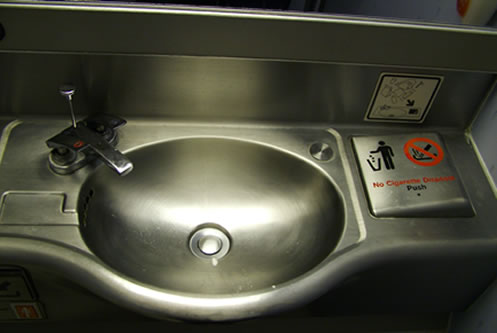
Washing your hands is a two handed affair involving a pair of hands, soap and water. There are instructions on how to do it properly. I’ve not done any research on it, but my gut feel is that most people wet and rinse their hands under a running tap (faucet). With this presumption, the Boeing airline toilet wash area is not fit for purpose. I adapt my behaviour to suit the technology. I press the hot and cold buttons down with my thumbs and attempt to rinse the rest of my hands under the running water. I could fill the bowl up, but (a) that is not my habitual behaviour; (b) wouldn’t that mean rinsing in dirty water and (c) those bowls are not always the cleanest of things anyway.
Seems like the design on the airline faucet was an engineering solution to an engineering problem. You don’t want to have the tap left running. So let’s make it really difficult to use. Let’s demand our users have to learn a new technique to use it. If the designers had considered the human factor, the design would probably be quite different. If they’d prototyped and user-tested the design they would have seen that it was sub-optimal.
Yet it is easy to criticise. (There is one good thing about it, it is clear which is hot and cold – assuming you know that red = hot and blue = cold). How could it be better? Maybe a foot control or infra-red sensor. But inevitably such solutions are costly to implement and costly to maintain. Why not a spring-loaded press button that gives a timed flow of water (not fail safe?) In designing solutions there are always trade-offs and compromises and maybe other more user friendly options were considered but discounted on the grounds of cost to implement or maintain. And as a customer in coach, a little hassle in washing my hands is an acceptable price to pay. But that is not going to stop me grumbling every time I struggle with the tap on the plane. (Oh dear, am I sounding rather obsessed?)