Archived entries for

If you say Log out, log me out

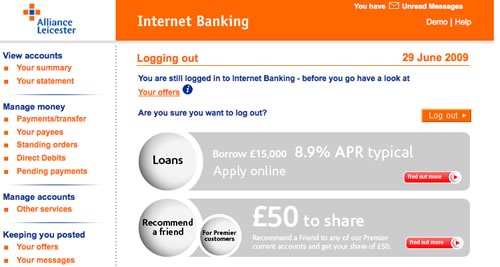
You’ve logged into your on-line banking checked your balance, paid your bills.  What do you do now?  Click on the logout button?

What do you expect will happen now?  Well given that you have actively chosen to log-out (it’s not something you are likely to click on my mistake), you’d expect to do exactly that.  Logout.  The next screen you get will probably be something that thanks you for on-line banking, with a cross sell for a product or two.

That’s what I assume most customers would expect.  So what are Alliance and Leicester thinking about with this screen?

The customer has clicked log-out but they are still logged in?

Why?

“You are still logged in to Internet Banking – before you go have a look at Your offers.”

Excuse me, I logged out, I don’t need to be logged in for you to show me offers.

Worse: “Are you sure you want to log out?”

OF COURSE I WANT TO LOG OUT!!! Why else would I have clicked the link.

Alliance and Leicester fail here in a fundamental usability rule, that of managing the customer’s expectation. In an application where security isn’t paramount this would be an error, in an application where customers expect their action of leaving their secure accounts will do exactly that… but doesn’t, is inexcusable.

SOA, architecture without foundation

Service Orientated Architecture (SOA) is something that is easy for the lay person to understand.  (Try getting a techie to explain REST and you will see the attraction of SOA to the business person – it’s understandable!)  Understandable, in my non-techie hands, is dangerous.  I am entirely unqualified to pass judgment on it, but there are a couple of  things I’ve observed and have been on my mind when I’ve seen SOA nastiness going on.  So excuse me whilst I wax lyrical.

Problem 1. IT haven’t got a clue.

My (lay) understanding of SOA: IT build ’services’ that can be consumed by different applications.  SOA enables us to remove duplication and build the foundations for a scalable architecture that will accommodate changing requirements as the business evolves and grows.  Herein lies the problem; IT build ’services’, second guessing what the business actually needs from said service.

Exhibit One:  Customer Details Service. It exposes details of customers to any application that will use information about customers.   It was designed by the architect in isolation based upon what IT believe a Customer Details Service will be required to do (e.g. the nature of the fields, the domain etc).  This is even though no application has been built, yet alone specified for (“we just know we are going to need customer details”).  It’s putting the cart before the horse.  But IT go ahead and build the service anyway, because they own SOA.   At a later date the business articulate requirements for a new downstream application that requires Customer Details.  It’s the Corporate Business whose domain is Corporate Customers.  But what happens?  The service doesn’t quite meet their requirements.  The fields are wrong.  The Customer Details Service fits the domestic consumer model but not the corporate customers model.  What gives? More likely than not the downstream application.  The corporate customer has to be shoe-horned into the domestic customer service. I’ve seen this done.

Lesson 1. Don’t build SOA in a void.  Get out of that architectural ivory tower and engage with the business (if you can get them to listen – see next point). Better still engage in Guerrilla SOA.

Problem 2. The business haven’t got a clue.

One of the sad realities of the corporate world is that walls that have sprung up and created internal silos that are difficult to bridge.  As the business, the consumer of technology, I want IT to deliver to my requirements, no more, no less.  If I am in the domestic consumer part of the business, frankly I don’t care about Corporate customers.  I’m fighting for my budget, and hell, if this SOA thing is going to cost more than doing a closed application that fits only domestic customers, that only I can use I don’t care.  I’m not going to pay for a “Customer Details” service that does anything except give me what I need to know about my customer.

Lesson 2. The architects should facilitate the discussion.  SOA is as much about your business vision as it is technical architecture.  Unless the business grasps what you are trying to do, drives the solution and requirements are both local and global, before long you’ll see some grand services that few use in the core and chaos is the periphery where the real business is done.

Bottom line?  All too often architects fail because they tend to focus upon the architecture part of SOA rather than the services.    Unfortunately, because of the siloed nature of so may organisaitons, unless it is driven by the architects it is unlikely to gain traction.  If there is a maxim that should be followed when considering SOA in an organisation, it is probably instilling the notion of ‘think local, act global’.

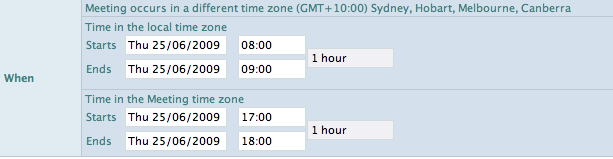
What time does the meeting start

Lotus Notes is a gem of a product for usability howlers. Barely a day goes by without me cursing or swearing at it.  Here’s an example of its dumbness…  Without thinking, what time does the meeting start?  I mean, what time do I, in the UK, need to dial in to the conference call?

Does this train go to Bangor?

Over the loudspeaker comes a garbled message “…this train divides at Chester.  Customers for Bangor must travel in the front four coaches of the train”.
There was a group of women behind me talking loudly, one of them picked out part of the message and was worried.  The train guard (sorry, Customer Revenue Protection Officer) walked by.
One of the women got his attention, “Excuse me, we’re going to Bangor?” she said.
“Oh” said the guard.  “You need to get out at Milton Keynes and walk to the front of the train”.
“What? We need to change trains?” the woman replied.
“No, it is the same train, just the front part of it.”
“Is it on the same platform?” Asked the woman.
“Yes, just walk up a little” replied the guard.
“We don’t need to cross over to another platform then?”
“No, it is the same platform, the same train”
“So why can’t we stay on this train then”
“Because this part of the train divides at Chester?”
“But we’re not going to Chester, we’re going to Bangor”
The guard was getting frustrated, “when the train stops at the next station, you just need to get out and walk up the platform, in fact to the next carraige and get on the train there”
“So why can’t we walk through the train to the next carraige?”
“Because it is a different train”
“but this train is going to Bangor isn’t it?  We are on the right train aren’t we?”

And so on until a fellow passenger jumped in “when we get to Milton Keynes, I’ll show you where to go” and at Milton Keynes he led them all off the train to walk past the train divide on the platform and I’ll assume they made it to Bangor in one peice.

The point of this narative is that not everybody “gets it”.  Just because you think something is straight forward or obvious doesn’t mean that your customers will.  You are not your customer, be wary of making assumptions on how people will use your Great New Product.


RSS Feed. This blog is proudly powered by Wordpress and is based on the theme Modern Clix..