Archived entries for

Why it pays to think about the whole system, not just your local function

Ability to do bulk price mark-downs? Nice to have.

Today we are looking at a large UK supermarket stock control system.  At the end of the day the staff mark down prices on the short-life items (sandwiches etc).  They have a hand held scanner with a belt printer.  Scan item – print label – stick label on item.  Well that’s what the process is supposed to be, only this takes time (20 seconds per item) and when you have a whole shelf to do is a chore (12 items takes four minutes).  Far easier to just write down the new price on a ‘discount label’ with a sharpie and stick it over the barcode (do the whole shelf in less than a minute).

Where’s the problem in that?  In fact three minutes of waste (waiting time) has been eliminated.  Only it is a problem

The customer takes the item to checkout and the mark-down label is covering the barcode.  The checkout colleague tries to peel it off to scan, but it doesn’t peel cleanly.  So she manually enters in the SKU. And the mark-down price.  And this has taken 2 minutes for one item and the queue has grown and because of the ‘one in front’ policy they have to open a new checkout and suddenly that small problem at one end of the value chain is replaced by a bigger costlier one at the front end.

But had we not observed this we would never know that bulk price mark-downs on the hand-held device is not a nice to have, it is million dollar requirement.

What do you see?

A cleaner and a doctor both watch a surgeon perform a complex operation on a patient.  Both watch the same operation, yet each sees a completely different thing.

Are you aware of how different people will see the product you are building?

I just want to talk to someone

I’ve got a query about an Account I opened with Alliance and Leicester.  I’ve got a letter that provides me with an account number and a phone number, it reads  “…if you have any further question [sp] please contact a member of the team on 0844 5619737“. So I ring the number.

“Please enter your eight digit ID number.  This is on your welcome letter, monthly statements, or internet banking ID.  It is NOT your account number.”

Hmmm. I don’t have any of those things to hand, they are not on the letter.  I’ve got my debit card, but that’s obviously on a different system.  I put the phone down and return to the letter, near the bottom, in bold it gives another number “if you would like us to send you information in the future in larger print…” I ring this number.  It doesn’t work.

So I go to the website and look for a telephone number.  I’m an existing customer.  I select my product and ring the number on the page.

“Please enter your eight digit ID number.  This is on your welcome letter, monthly statements, or internet banking ID.  It is NOT your account number.”

I don’t have that information to hand.  I choose another product.  Same message.  I’m getting frustrated.  There’s a page titled “Other enquiries“.  Lots of words, but no number.  I navigate to the complaints page, it has a number.  Hey! Kill two birds with the same stone, speak to someone in their complaints department, make a complaint about how my time is being wasted trying to find a number and get transferred to the relevant department.

I dial the complaints number, more IVR and the prerecorded message.

“Please enter your eight digit ID number.  This is on your welcome letter, monthly statements, or internet banking ID.  It is NOT your account number.”

Frustration turns to anger.  I find a number for new customers.  I get through the IVR and finally talk to someone.  “I need to transfer you to the relevent department” she says.  OK.  The line goes silent.  And then goes dead.  Lovely.  Stress.  I give up and start the motions of closing the account.

There’s nothing unique about Alliance and Leicester.  I hate to pick on them.  But this seems like a case of a lack of joined up thinking.  When you are designing processes or procedures, don’t just think about them from the business perspective, take a persona and test them with real people in roll plays.  What if someone doesn’t have what you expect them to have?  Customers do not always behave according to the expected happy path.  What are you doing about that?

What would Sally do? Personas for retail financial services

Personas are ‘pen portraits’ that bring to life users or customers of a system, service or product.  Giving a personality and back story to your customers helps keep your thinking true to their real needs and goals.  Rather than using  ‘user’ or a segment descriptor such as ‘empty nester’, or ‘this is what I would do’, what would Sally do?

Here’s a set of personas for financial service organisations, geared towards the retail / B2C market.  Sally is included (Shes skint).

View more presentations from marc mcneill.

Who would turn off the wrong engine?

In designing user interfaces there’s a lot we can learn from systems where failure to consider human factors has resulted in terrible consequences.

On 8th January 1989 British Midland Flight 92 crashed whilst attempting an emergency landing. There had been a fire on one of the engines which led to its malfunction. The captain reacted by shutting down the engine.  Only he shut down the wrong engine. With no power, approaching East Midlands airport the captain manged to glide the Boeing 737-400 to avoid Kegworth village but crashed short of the runway.  47 people died.

The investigation into the Kegworth air disaster identified engine malfunction (the engine used in the aircraft was an upgrade of an existing engine and had not been field-tested) as causal factor, however the report concentrated upon the failure of the flight crew to respond accurately to the malfunction.  Human error was the primary cause.

The truth is a little more complicated than that.  Why does a captain with over 13,000 hours flying experience and a first officer with over 3,000 hours experience shut down the wrong engine?

A number of human factors contributed to the disaster including organisational issues (refer to this paper for discussion of the role of managerial failures in disasters) and cognitive overload.  But of equal importance (and indeed buried in the appendices of the Investigation Report appendices) is the issue of design. Around 50% of accidents and incidents in the aircraft and nuclear industries have a root cause in design (source).

Take a look at the cockpit controls (taken from the investigation report). The left image is for the earlier 300 series and the right for the 400 series aircraft on which the captain had only 23 hours experience after a one day training course.
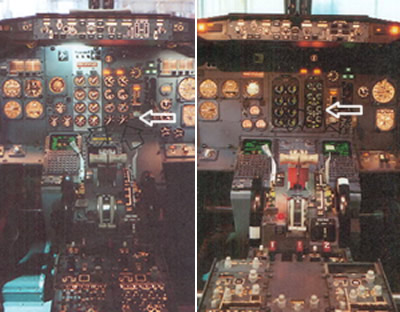
The actual cause of the engine malfunction was a broken turbine, itself the result of metal fatigue caused by excessive vibration (source).  Had the Captain noticed the Vibration Warning display he probably would not have made the wrong decision.

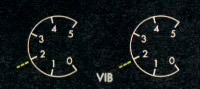
The Vibration Warning display on the new 400 series was in a different place to the 300 series, but more critically it was designed to be significantly smaller “the dial on the vibration meter was no bigger than a 20 pence piece and the LED needle went around the outside of the dial as opposed to the inside of the dial as in the previous 737 series aircraft” (Source: Wikipedia).  Take a look at the arrow on the left hand image, the display dials on the 300 series use mechanical pointers. On the 400 series they were redesigned with short LEDs rotating around the numbers. These, as the investigation report noted “are much less conspicuous than mechanical pointers, acting more as scale markers, and providing less immediate directional information).
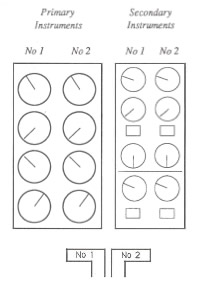
The report criticised the layout of the instrumentation and helpfully suggested an improved layout.  The layout was (and as far as I can tell, remains in 737s) split into primary instruments and secondary instruments.  The issue with this layout is that the dials are not spatially aligned with their associated power levers.  If the pilot is focussing upon the primary instrumentation, the secondary instrumentation is in peripheral view.  This layout will lead to attention based around specific instruments rather than engines.
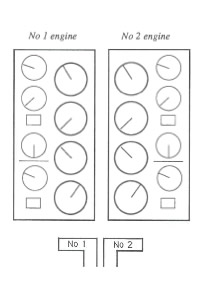
Compare this to an alternative design that the report provides where the dials are aligned to their associated power levers.  The report recognises the design trade-offs here but concludes that to break the left-right mental association with the engine position was probably not the most optimal solution.
This paper describes the issue well:

The 737 involved in the East Midlands crash had flight deck engine information that lead to confusion under mental pressure. Placing the secondary information sets for both engines to the right of the primary set broke the implied rule set by all the other engine information, that the left engine had left hand controls and indicators (and vice versa). If one assumes that the optimum positioning of indicators is the one that requires the least mental processing then a simple symmetry about the aircraft centre line seems appropriate. The actual positions required a mental spatial transposition of one set of dials to the other side… The readability of the indicators had been reduced by the substitution of electro-mechanical readouts with electronic readouts, but which simulated the old design. Possibly the redesign to electronic readouts should have taken the opportunity to use a rather different layout, possibly with linear indicators rather than rotary ones.

OK, so lots of words, but what is the point of this to what I usaully blog about?  The issue is one of design and layout and who’s responsibility is it.  In designing user interfaces UCD is often seen as a luxury, developers believe that they can design a GUI as well as anyone, and stakeholders (especially on internal projects) will question the value that a UCD person can bring to the project.  Does a developer or an engineer by training and instinct stop to ponder the human factor and the human consequences of the GUI layout? What are the consequences of this?  As can be seen from Kegworth, seemingly minor changes to the control layout can have a signficant impact on the safety of a complex system.

Who do you beleive?

Only Five Percent Of Readers Would Pay For Online News. (Sep 20, 2009)

16 November two new reports come out simultaneously.

Research from Boston Consulting Group suggests that as many as 48% of British and American consumers would be willing to pay a few pounds a month for online news.

According to a new Forrester survey, almost 80% of Internet users in the US and Canada would not be willing to pay for access to newspaper and magazine websites (via readwriteweb).

So 5%, 20% or 52% of people will pay for online newspaper content.  Or maybe 12%. And Murdoch is going to “rewrite the economics of newspapers” based upon that kind of customer insight?  It is going to be interesting to watch.

About a successful project that was a failiure

On time, on budget, to the scope that was agreed from the outset of development.  A successful project?  Well no actually.  It was a complete failure.

Here is a story about an insurance company with a number of differnet products sold through intermediaries.  Whilst the intermediaries were good at selling single insurance products, they weren’t so good at cross-selling or up-selling other products.  Focus groups with the intermediaries revealed that they didn’t know about all the other types of insurance available through the company.

What if the intermediaries could have a portal where they could access all our insurance products in the same place with customer alerts and sales support prompts identifying further selling opportunities?

From this initial idea a benefits case was pulled together consisting of a product definition and financial projections.  In pulling together the benefits case, the potential revenue uplift numbers surprised everyone.  Signing off the benefits case on the new Intermediary Portal was duly signed off, and the product definition was handed over to IT to build.

Being an agile IT shop, the business and developers sat down together and got their heads around the product definition.  It soon became clear that the challenge was one of “single sign-on”.  Each of the insurance products offered were on a different legacy application that required the intermediaries to sign-on with different credentials.  To bring them all together in a single portal was far harder than the simple problem that the initial product definition suggested.

In pulling together the benefits case, a rough estimate had been supplied by IT. Now it was an in-flight project with an initial list of stories, it became clear that they had significantly under-estimated.   Of the twenty different products that the business wanted on the portal, for the budget the business had set aside would deliver barely four products.

With new estimates a release plan was drawn up.  Release one would deliver single sign-on across four products identified by the business as being most profitable.  All the  sales support tools were de-scoped and scheduled for a third release with the second release delivering single sign-on for the remaining products.

Development started, the business stakeholders worked closely with the developers and the First Release of the Intermediary Portal went live with congratulations all round.  Funding for the next release was lined up depending upon the success of the first release.  But that success never came, take-up was less than expected and the cross and up-selling never materialised.

The proposition to the intermediaries as delivered was flawed; the portal had to be all or nothing, single sign-on across four unrelated products was not compelling to them.  There was no sales support.  The intermediaries thought “so what?”  IT had delivered on the business requirements yet the project was deemed a failure.

This story tells a striking lesson. The project failure was due to a lack of joined-up thinking.  The business and IT both had followed their processes and done the right thing.  The business had identified an opportunity, built a benefits case and had this signed off.  IT had run a model agile project with close engagement with the business.  However whilst both stages of the process were locally optimised, they were done in isolation of each other.  Once the (development) train had left the station both sides were committed to delivering the product portal.  No-one returned to the business case, no-one went back to the end users, the intermediaries and asked whether the cut down scope for the first release would actually be of value to them.  More importantly, IT were engaged too late in the process.  The business had settled on an IT solution to the problem without engaging IT.  Had IT been party to the ideation and visioning process they would have been able to raise the risk of the project complexity earlier on.  Indeed they could have killed the project before it started.

Returning to the initial problem; “intermediaries weren’t so good at cross-selling or up-selling other products… Focus groups with the intermediaries revealed that they didn’t know about all the other types of insurance available through the company.”  The problem didn’t need a portal solution. The issue was one of awareness; almost certainly an off-line marketing campaign would have delivered a greater ROI without the need for IT to build the wrong product.


RSS Feed. This blog is proudly powered by Wordpress and is based on the theme Modern Clix..