
Pillars of a compelling experience
This is a model I often see in organisations when it comes to their web presence. A product owner comes up with a commercial proposition, marketing work up the content, IT build the functionality and it is goes live. With this model, no-one actually owns the customer experience.
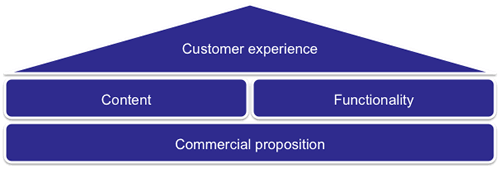
Worse, this little temple model is repeated across different commercial propositions so you end up with something that is not very joined up. I’ve blogged about this lack of joined up thinking before.
Now let’s construct a model where the roof of the temple is a compelling customer experience.
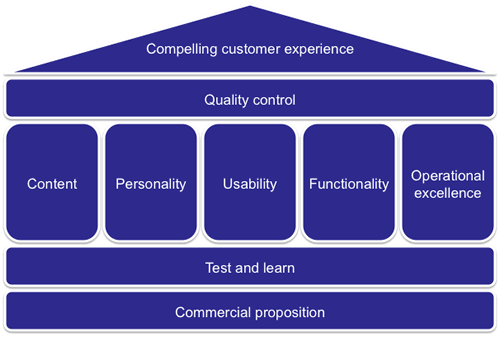
What are the ingredients of this new temple model? It is still going to be founded upon commercial propositions, but they are going to be overlaid by a culture of test and learn. That is a willingness and ability to experiment; to realise that what you have developed is never final and is always evolving. It is about taking the learnings of experiments to inform and improve the experience, or to rapidly refine or kill propositions that just do not work.
Then we have the five pillars. I describe these in a paper I wrote ages back (pdf here, google books here).
Unfortunately these pillars tend to sit within organisational silos; content and personality are ‘owned’ by marketing, functionality by IT, and operational excellence (that’s all about fulfilling on the customer promise and beyond) is a mixture of IT and operations. Usability is a ‘funny one’ in that might sit alone, sit in marketing or sit in IT. But ultimately it is best placed to direct the horizonal filter of Quality Control. Quality control is not an additional layer of bureaucracy, rather a cultural component that all the pillars feed into. It is about ensuring consistency and meaningfulness of the experience. It is about balancing the commercial needs of the product, with the marketing needs of the message and the delivery capability of IT.
Photo credit: K. Dafalias