2007

WWW. Why. Why. Why.

The www prefix is redundant. Technically, and now, given the ubiquitous nature of the web, in marketing as well. So why do companies insist on retaining it. Worse, why do some companies have URLs that only work with the www.? This is sloppy, a couple of lines of code would direct either company.com or www.company.com to the correct IP address. There are some big names who suffer from this sloppiness. Will ’07 be the year that WWW, an acronym that takes longer to say than to write, drifts into history?

Blue is the colour. The website isn’t the game.

So I may support Chelsea on the pitch, but on their website? Oh dear me. It’s as though they got someone who has just learnt flash to build it – to use as many flash animations as possible. And any website designer that incorporates a link on their splash page (why oh why a splash page) that says “check out the site demo” and a first message “learn how to navigate through ChelseaFC.com” needs to be questioned. Learn how to navigate a web site? Oh please!

The nature of football fans is their brand loyalty, but to give them something that visibly takes time to load (page loading status bar), requires instructions to learn how to use, and doesn’t make things easy – support me achieve my goals – is frankly insulting.

Oh, and they’ve got a text only version (the CFC Flash website isn’t going to win awards for accesibility so one can only presume this is the only reason it is provided) but the splashpage requires JavaScript to load up, so no JS and no website, regardless of any text-only goodness that may be there. So not an accesible website then.
Meanwhile the community stuff that supporters care about (beyond the news and match reports, it’s probably going to be the most sticky content) is a seperate site that looks like it was built in the early days of the web. I mean, who uses frames anymore.

Sorry Chels, poor show. Your league status doesn’t extend to your on-line prescence.

Why the number not the user name?

User name and password. Ever since setting up my first hotmail account, since buying my first book on amazon these are the two unique peices of information that securely identify me. It’s a pattern I’m used to. Sometimes the username I want will be taken, but I’ll find another one. I remember my user names. Passwords are a little harder, I seem to be forever changing them, but at least with a user name I can usually click on a link to get a password reset emailed to me.

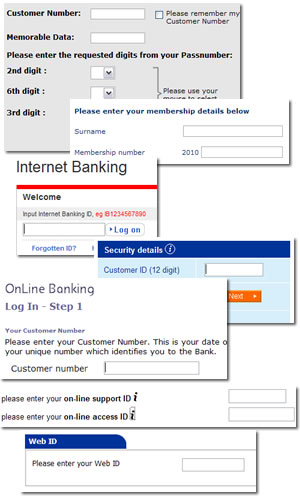
So why do the banks do the whole identifcation thing differently? The majority of banks don’t allow you to have a user name that you define. They allocate you a “customer number” or a “membership ID” or some other randomly generated number that you are almost certainly not going to remember. You are going to write it down. So this number can’t be more secure than a user name. And it is not as if you don’t already have a plethora of numbers with the banks; card number, account number, sort code. Couldn’t they use these numbers as identifiers? With HSBC you can generate your “IB” number from these information, but it is a more lengthy procedure. First Direct have an on-line support ID and an on-line access ID (whatever they are!?)

Security is paramount with on-line banking; as banks renew their security infrastructure they should review the customer experience; how security manifests itself to the end user and how easy it is to use, as well as ensuring it offers the highest level of protection to themselves and their customers.

bank sign on

Success is more than just features

All too often there is an assumption that we can deliver a bunch of features and they will provide a benefit to the customer. A simple model and it underlies much of what agile is perceived to be about. Deliver those features that provide greatest (business) benefit at the earliest opportunity.

Features leads to benefits

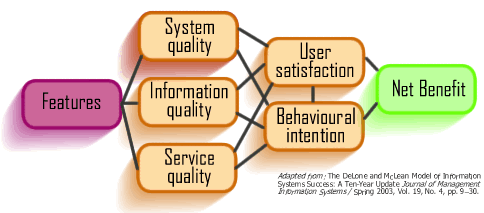
It is worth looking at the updated DeLone and McLean model for Information Systems (IS) success [pdf]. This is a causal model; if you want to accrue benefits with a system it is not sufficient just to deliver “features”. There are qualities that must be realised; these will drive an intention to use and actually use the application. This is tightly correlated with satisfaction, use will precede satisfaction, but if the outcome is satisfaction then use will increase and this is the ultimate test of how beneficial a system is.

DeLone and McLean model for IS success.  Slightly modified.

So taking the “qualities” one by one:

System quality: e.g. reliability, usability, performance, availability, accessibility
Information quality: e.g. usefulness, personalisation, speaking the user’s language, keywords, search terms
Service quality: the overall experience, interface design, emotional impact, trust, security, support

Typically development teams may consider some system quality attributes as “non-functional requirements” but these are generally from a technical perspective (e.g. availability) rather than a human perspective (e.g. usability). Probably this is because this is the language that development teams understand.

Information quality is usually left to someone else, someone from the business, from marketing, to write the copy for example. On the web, where most customer experiences start with search so getting copy right is essential to ensure search engine optimisation. On pages that are not content managed, pages that the developers are coding have meta-tags been identified? Has copy been written with targeted keywords in mind, keywords at the beginning of the page, with repeated use of the keywords etc?

Service quality is something that everybody assumes will be manifest but is rarely explicitly stated as a measurable component. I recently worked with a client that wanted to offer “world class” services. What did this mean? Asking them resulted in different things to different parties. The DeLone and McLean is a little light on “service quality”. Depending upon the application, it is something that looks and feels good, and makes me feel good using it. It is something that delivers a complete and holistic experience from the first point of contact (e.g. hitting the home page) through to realising my goal (e.g. correct products ordered arrive at promised time).

These qualities have a causal impact on use and user satisfaction. These can be measured (e.g. usage patterns/ repeat usage/ surveys) and should be incorporated into the non-functional requirements at the outset of the development.

Get all this right and you will realise net benefits from the project.
11 of 11
7891011