This made me smile
In financial markets, the traders love spreadsheets. It’s easy to wonder why and fight the trend. This cartoon, Captain Agile and Fubar – Listening ain’t easy made me smile.
In financial markets, the traders love spreadsheets. It’s easy to wonder why and fight the trend. This cartoon, Captain Agile and Fubar – Listening ain’t easy made me smile.
I was recently involved in a prioritisation exercise. The application included a UI that presented large numbers to users in financial institutions. The business owner (sadly there was never any question of acutally talking to end users) had complained about how easy it is to make mistakes when adding loads of noughts to a sum – and pondered that it would be great if when the user tabs away from the field that long number is entered, that comma seperators should appear:
i.e. he types 1435245001.00 and on tabbing away the number appears as 1,435,245,001.00.
Cool! It’s captured as a requirement and we move on.
When we go through our prioritisation, it is considered to be a “nice to have”. With a bulging requirements list and estimates squeezing the list, this requirement is initially an early one to go. After all, what business value does it add? But this is where the planning process must be iterative.
The effort to implement this requirement is nominal. Whilst the “business value” is considered nominal, the value to the stakeholder who requested it is emotionally signficant.
When we showcase the story that demonstrates the ability to work complex financial algorithms based upon the number the user enters, the stakeholder will nod his head and say “great”. It does what he expects. But how good will he feel when he sees the commas appearing? Little cost to implement, zero identifiable business benefit, but significant stakeholder emotional benefit.
As a project, when the key stakeholder leaves the showcase, how would we prefer him to feel? “yep, that’s what I want?” or “Gee those guys are good”?!
Before Christmas I received a letter from either Hilton Hotels or British Airways that as a BA frequent flyer I was entitled to a Hilton Honors VIP Gold Card. Indeed the Gold Card was enclosed. I scanned through the letter, and stuffed the Gold Card into my wallet – on the off chance that I would stay in a Hilton Hotel in the next few months – within the period for the card to be activated.
A couple of months later I found myself in Glasgow and was booked into the Hilton. On arrival on the first night I handed over the card. I mentioned that I thought it needed activating. The receptionist took the card and swiped it, and offered me a room upgrade as a VIP customer. Great! I presumed that this meant the card was activated (an inactivated card would not be accepted by their system right?) Over the next few weeks I banked the points on the Goldcard, the number was logged at the top of my receipts and I was a generally happy chappy. Until I logged on to their website to find out how many points my card had earned. The card number was not recognised. So I sent an email to Hilton explaining the above and this is the response they sent me.
thank you for your email. The card which you received was sent to you as part of a promotion by British Airways. For the membership/Gold VIP status to be valid, you would have needed to call us before May 31st 2006 to have your card activated. As this was not done, this would explain why your account number was not recognised by our website.
I have taken the liberty of activating your card for you so that you may begin using it. Your account, however, has Blue membership status, as the promotion which entitled you to Gold status has now expired. We can credit you with points for any eligible stays you made with us within the 3 months prior to today. If you have copies of the bills for any such stays, kindly forward them either to this email address or to the fax number listed below, indicating your HHonors account number, so that we may update your account accordingly.
Now I am puzzled. Why was a card that was not activated, accepted by their system? (Where did this record go to?) Why were they unable to retrieve details of stays against a card number that was entered into their system? And how could they give me Gold membership with a card and account (which can be activated now) but withdraw the offer, despite my having stayed at your hotel and enjoyed the Gold VIP status during my stays. When I challenged them with this I received the following response:
The letter which you received with your promotional Gold VIP card would have clearly stated that you must call to have the card activated before May 31st 2006. As you did not do this, the account was not activated in our system and your stays were therefore not registered against it. We regret if you have been misinformed regarding this, i.e. that our hotels were accepting your card even though it was not active. We are, however, unable to honour you with the Gold status you were offered, as you did not fulfill the criteria of the promotion, which has since expired.
Do I have a warm feeling towards Hilton now? Not really. The promise of a loyalty card that would have driven my return business (and reccomendation to colleagues) has been dangled before me and cruelly snatched away. Worse, my conversation about Hilton is now this story of a poor experience. And what is a hotel if it is not an experience?
Take a look at the Orange website. Who are you? What is your motivation for visiting it?
I’m an Orange customer and I’m looking for information on thier phone insurance. I’m a Googler, I don’t browse, I search. I enter my query in the search box…
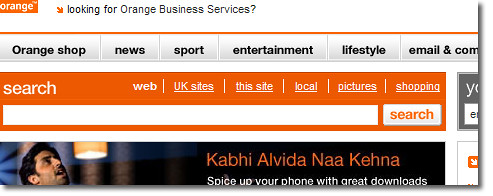
And I get these results:
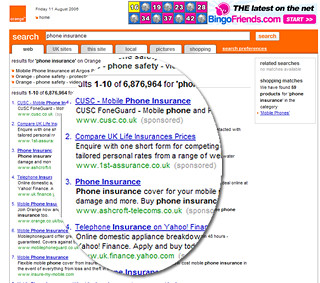
Eh?
Compare UK Life Insurance prices??
Why would I want to search the web via the Orange website?
I thought we’d moved beyond the Portal concept. Customers generally “jam jar” their experiences. If they want news, they will go to a news provider – bbc.co.uk. If they want search they go to Google..
Clearly their strategy is to move Orange beyond being a provider of phones and tariffs, to become an integral part of their customers life. Regardless of channel you get the same consistent and compelling experience. And if that experience is sufficiently sticky, they’ll drive revenue off the back of it. That’s the motivation. Yet sadly they have forgetten about the simple things. They’ve forgotten about the most of us who want simplicity from our phone provider.
The Orange search box is a good example of a brand that has great aspirations that look great on Customer Strategy PowerPoints (“We’ll be our customers information gate, regardless of channel”) but overstretches itself by forgetting what customers actually want (“how much will phone insurance cost me”).
As agile practitioners we wax lyrical about “the customer”. But who do we actually mean?
More often than not it is the “business”. A vendor relationship is implied, with IT supplying goods and services to the customer, who is the business. But the business is not really the customer. They are more an intermediary. An intermediary who in turn provides the product or service to the people who will consume them; the real customers. Yet if these real customers or consumers are considered at all, they are relegated to the title of “users”.
Calling the business “the customer” is an artificial construct based upon an arms length relationship between business and IT. Once this boundary is removed the real customer emerges. Moving beyond the vendor relationship between IT and business towards a partnership ensures a common customer. And ultimately it is this customer that fuels an organisation.
(In the CIM marketing glossary, there is no entry for “user”. There are two for “consumer” and six for “customer”. Not all projects will involve retail customers – think of call centre dudes. But I think the point is consistent…).
Success is rarely delivered by one part of the organisation; it requires the collaboration of different departments working together. Yet there is all too often a separation of responsibilities that can hinder the efficient development of ideas. Worse, there is no single owner of the business case resulting in business value being lost.
A crude model illustrates this. The “business” holds the business case. They are focussed upon the benefits case. IT are treated a factory to build the mechanisms that will support proposition and are thus focussed upon the costs. The customers (who ultimately use the proposition) are held at arms length and not involved in the development of the proposition.
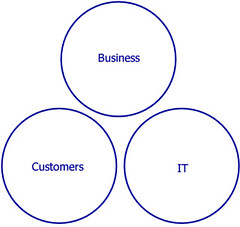
There can often be a tension between the business benefits case and the IT cost to deliver. The cynical view of the waterfall approach is that Business want it all, IT promise it all and their relationship deteriorates as the project nears its scheduled completion; IT cannot deliver on time or budget, the business has to make unplanned compromises and ultimately the customer suffers. The Agile approach goes some way to mitigating the risk of relationship breakdown. Painful messages about what can or cannot be delivered are communicated early on, enabling informed decisions to be made. However if the organisation is structured with clearly defined boundaries it is far harder to make truly informed decisions. As soon as scope changes, the business case will change. What often happens is that IT adjusts the numbers on the cost side, but the benefits case remains unchanged. If the business has spent many months working on the benefits case it is difficult to make changes on the back of an afternoon’s reprioritisation exercise. There is a solution to this. Taking an inclusive approach to proposition development and delivery; having all parties involved from the outset.
Here’s another crude model. Rather than being separated, the different stakeholders converge. There is a cross-pollination of ideas and understanding. The business case is shared, iteratively and incrementally developed. Customers are engaged in the process; providing market insight and testing the user experience. There is nothing new in this model, although I rarely see it working from the project outset. Often two of the three circles converge; the challenge is to get all three overlapping. I’m pleased to say at ThoughtWorks, increasingly when we initiate projects we are doing this.
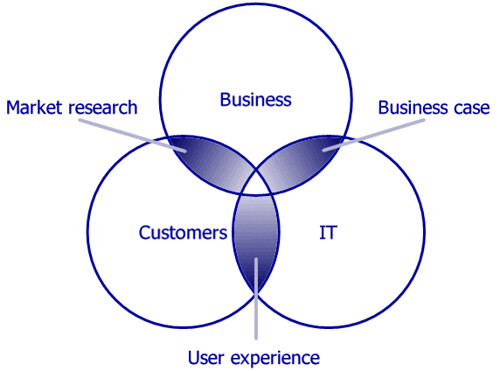
Often we focus upon business value. More often than not this means “the business” saying what is most important to them. There are often requirements that are mandatory parts to the project, but do not drive any business value in themselves. For example compliance and operational support. It is thus essential to invite all stakeholders to prioritisation workshops and be clear with the language used when commencing the prioritisation. Rather than just asking participants to ascribe “Must have”, “should have”, “Could have”, “would like to have / won’t have” (“MoSCoW) priorities to requirements without context, ask them to group their requirements into clearly defined chunks of functionality that can could be delivered as a self-contained releases that would deliver “business value”. In this way you are more likely to have “must haves” that make sense to all parties involved.