June, 2007

It’s how you ask it…
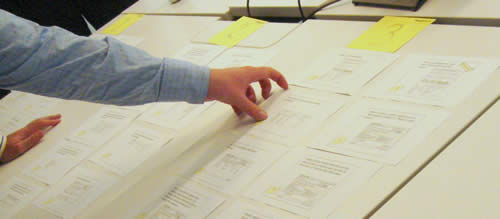
Prioritising requirements

You’re running a workshop and the group have come up with a bunch of new propositions. You want them to vote on which ones to take forward to the next stage. Or maybe you’ve identified a bunch of functionality and features and you want the group to prioritise what they’d like to see built first. What question you ask the group next is critical to the answer you will get.

You need to frame the question appropriately and make it clear to the group the criteria by which they are making their vote…

Do they need to be thinking about “do-ability”, the ease to implement, or do they need to be focussed upon the innovation and the idea itself. Should they be considering the cost to implement, time to market, return on investment, or should they be thinking about the art of the possible; the “blue sky”; the destination, regardless of the journey to get there.

Which line of thinking they should use will depend upon where you are in the process. Get them thinking about practicalities of implementation too early and you are likely to dilute the vision. Too late in the process and you will have candidate propositions or features that by their complexity or uncertainty will never the light of day.

So two tips. Before you ask the group to vote, or to prioritise, clarify the objectives and the critiera by which they are to decide. Maybe ask them to assume a ‘persona’ and vote in the way they’d expect the persona to vote, for example a customer will have different priorities to a developer.  Whose vote is it anyway?
And after they have made their vote make sure you manage the group’s expectations. Don’t let them leave the room thinking what they’ve decided upon is final and binding. It rarely is.
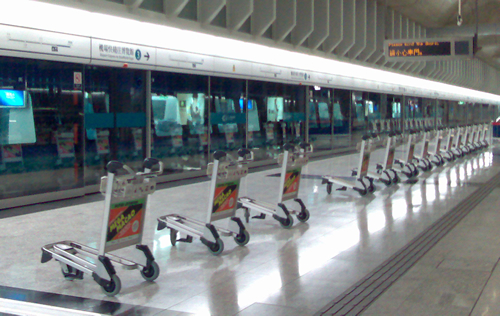
Forty five grand to line your trolleys up?

Trolleys lined up at Hong Kong MTR station

They’ve thought about the customer at Hong Kong airport. At every MTR station on the express route to the aiport, the trolleys have been lined up so that they are in front of the passengers getting off the train. No hunting for a free trolley – they are waiting for you! Nice!

But stop to think about that. Someone is employed to line up the trolleys. Given the hours the station is open (18 hours) it is going to be more than one person every day, more likely two; three to cover shifts across the whole week. Trains arrive every 15 minutes, so there will be other tasks for this role to do, but if they are offering a consistent customer experience then the focus will be this role.

So let’s work a UK equivalent, we need to employ three additional employees at, say, £8 per hour. Once Employers National Insurance is factored in (and not including sick pay or any benefits) that’s about £15k for each individual, or an optimistic £45,000 pa for the customer experience of having the trolleys lined up.

Justify that to the beancounters…

Code I understand

ThoughtWorker’s blogs are aggregated on Thoughtblogs. At a high level, they can be divided into two categories:

1. The written word, sometimes with photos and illustrations included
2. The (techie) written word, with a few intelligible sentences followed by blocks and blocks of code.

I enjoy the former, but I’ll confess the latter is usually gibberish to me. So what joy it is to read a blog that describes code, that is eminently understandable. Behaviour Driven Design that Dan talks about not only makes sense, it is also understandable to someone like me who is not a code polyglot. My last blog was critical about the Business finding themselves talking the same language as IT… how refreshing it is to see code talking the language of the Business.

What is your business?

Should “the business” care about IT? Should an investment bank trader know anything about XML, or a marketeer know anything about SQL? Probably not. Even less so should they be talking to their IT colleagues of their requirements in these terms. The business should speak to IT in a language of value driven requirements rather than implementation detail. Yet in many organisations (where IT has historically had a track record of failure), the business has taken a greater interest in IT delivery. They start talking the language of the techie. When this starts to happen business operations no longer see the clarity of their business. They see systems. In an investment bank setting: the trade is booked in Zeus. Settlements are handled by Minotaur, payments by Socrates. Corporate actions are handled in Hades. Depending upon the geographic region, client management might be handled by Tomsys, Dicksys or Harrysys. You ask a business person what do they do and they talk in terms of systems. Getting down to the underlying requirements of what they actually want to do is hard. Innovation and creative thinking are hard because we always return to what the limitations of the current systems are. Why there is a requirement for a Reconciliation System rather than asking why there needs to be any reconciliation in the first place.

So here’s a suggestion. Act dumb. Forget everything you know about the way you do things and go back to first principles. How would things be if we were starting from scratch. How would you describe your business intent (not the what you do now, rather what would you do) if you had to explain it to a novice who was starting a competitive business to put your business out of business. I doubt the word system would come into the description.

Missing planes

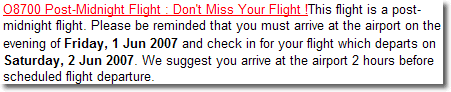
Reminder to get to the airport on the the right date.  flight is post-midnight

After a month living out of a suitcase, circumnavigating the globe I’m homeward bound. I’m flying with Oasis… going to be interesting how the words “budget” and “longhaul” reconcile with each other. So far the experience is promising, a nice touch with their e-ticket (the date which I have subsequently changed). The plane flies at 00:50. BA fly back from Hong Kong a little earlier; on their e-ticket they don’t make it clear that the flight is a post-midnight one. Last time I did this trip I arrived at the airport on the Sunday night beleiving my flight was late on Sunday. Only it was a few minutes after midnight… on the Monday morning. I’d missed my flight by 24 hours. An easy, and expensive mistake to make. Oasis have gone out of their way to help me not make this mistake.

The little things really do count

Ever since I saw Joe Walnes demonstrate it, every project that I find myself on which has a search requirement, it is never long before I am trying to convince the team that a “find as you type” search mechanism is the way to go. Usually everyone is in agreement, but occaisionally stakeholders try and de-scope it saying it is low priority “gold plating”.

Now look at the way that google finance and yahoo finance handle their stock ticker search. Over time, tell me which one you would prefer to use? Tell me that the Google search is just “gold plating”.
It gets worse for Yahoo; they treat tickers and stock names seperately, requiring different searches. As The Stawart states “the fact that Yahoo has its ticker search and its name search in separate boxes, after all this time, seems downright negligent.

Are you building a potato or a Sensation?

The humble potato is not worth a lot. The farm gate price for a 150g spud is negligible. How do you add value? How do you turn a worthless Maris Piper into a valuable commodity?

Potato

Potato crisps (chips) are a great example of a low value product being turned into high value one.

Walkers salt and vinegar crisps

But that’s the easy part. The real value add is further transforming the product without fundamentally changing it. Innovation through packaging and marketing, making a basic product appear more desirable. Appealing to higher sensations beyond just satisfaction; differentiating the same basic product into an up-scaled, up-market luxury item. The same item that customers will happily pay more for.

The retail price for a 50g bag of Walkers Salt and Vinegar crisps at my local One Stop is 35p. The price of the Sensations bag is 47p. (For reference the retail price of a 50g potato – is 5p). Now I’m no crisp expert, but I’d guess that the incremental cost for adding a couple of new ingredients to the flavour is marginal. There’s some sunk cost in product development- creating the new flavours and developing the new brand, but this is little effort compared to the benefits that will be accrued.

Walkers Oven Roasted potato crisps

But that is not the end of the story. Focussing upon the experience of the Sensations product, Walkers see an opportunity to change the packaging – to increase the bag size. Now their basic Sensations product is a whopping 150g bag that retails at £1.35.

Walkers Lime and thai spices crisps

Sometimes it is easy to focus upon just delivering the basic package, to just satisfy the customer. Is there anything you can do on your project to transform delivering the hygiene of customer satisfaction, to selling a compelling value-added experience?

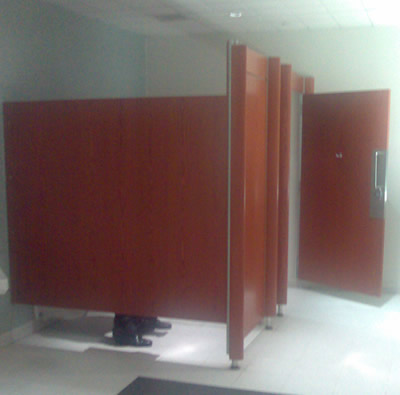
Cultural differences in toilet walls

US executive toilet gap legs and all

What do you see? Depends on who you are. In the US it’s just a row of toilet cubicles. Elsewhere in the world it is “what’s with the huge gap between the floor and cubicle wall? A gap large enough to see the legs of the person in the cubicle next to me!”

Apologies for dragging this blog to the level of the toilet, but there is a point to this observation. Things that are normal in one culture may not be quite so normal in other, even the most mundane. On distributed projects with off-shore teams it is not enough to ensure you have robust processes and open channels of communication. You need to ensure that cultural differences are understood and respected. Don’t assume everyone shares your design of toilet.

It’s not what you’ve done, it’s what you’ve acheived

This is a good way to assess where you are going in life.  It’s not so much what you’ve done, it’s more about what you’ve achieved.  Great, so you’ve written a marketing plan, you are an expert in Java, .net and Ruby on Rails.  But what have you actually achieved?  What did that marketing plan result in delivering?  Who did you delight with the applications you built in Java, .net or Ruby on Rails?  What value have you personally contributed to the world?  What would your epitaph be?

1 of 2
12