July 2007


Should “the business” care about IT? Should an investment bank trader know anything about XML, or a marketer know anything about SQL? Probably not. Even less so should they be talking to their IT colleagues of their requirements in these terms. The business should speak to IT in a language of value driven requirements rather than implementation detail. What is the outcome you need or want, not how you think IT should deliver or implement it.

Yet in many organisations (especially where IT has historically had a track record of failure), the business has taken a greater interest in IT delivery. They start talking the language of the techie. When this starts to happen business operations no longer see the clarity of their business. They see systems. In an investment bank setting: the trade is booked in Zeus, settlements are handled by Minotaur, payments by Socrates. Corporate actions are handled in Hades. Depending upon the geographic region, client management might be handled by Tomsys, Dicksys or Harrysys. You ask a business person what do they do and they talk in terms of systems. Getting down to the underlying requirements of what they actually want to do is hard. Innovation and creative thinking are hard because they always return to what the limitations of the current systems are. They focus upon the requirement for a Reconciliation System rather than asking why there needs to be any reconciliation in the first place.

So here’s a suggestion. Act dumb. Forget everything you know about the way you do things and go back to first principles. How would things be if we were starting from scratch? How would you describe your business intent (not the what you do now, rather what outcomes you really want to achieve) in simple terms to a complete novice. I doubt the word “system” would come into the description.
Michael Klynstra writes enthusiastically about Meosphere. My first impression is that I’m not so sure. It may be a cool and compelling proposition but it is not obvious to the visitor what it is all about. Needing a large call to action “Click here to see how it works” should set the alarm bells ringing. The target audience (I assume) are typically time poor and have limited patience or attention span. Why should they invest time into learning how to use the site, let alone actually interacting with it? This is where Facebook is so good. Blindingly simple home page:

Facebook is a social utility that connects
you
with the people around you.

Clearly expressing the site’s value proposition from the outset…

It’ll be interersting to see how Meosphere get on. Good luck to them, but I wonder if they could have made the home page slightly more compelling and inviting to an unitiated user… Having said that, once they’ve got a community and people are emailing links, is that so important after all? When I signed up to Facebook, it was on the basis of an invitation rather than a visit to the homepage. So maybe if Meosphere get critical mass of community then homepage design isn’t so important and indeed Michael’s words will come true; web 2.0 at its best.

(Oh, and I drove a 1967 Volkswagen Microbus at “highschool”).

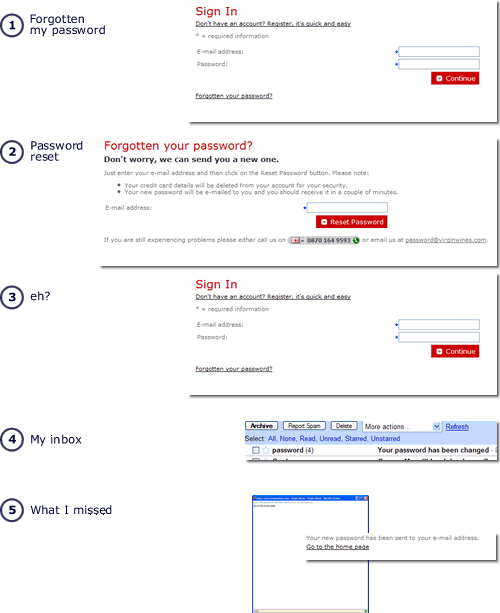
forgotten password process as virgin wines
Here is an example of sloppy execution of a simple process. Logging into Virgin Wines and (1) the user has forgotten their password. They click the forgotten password link and (2) are invited to enter their email. They hit the reset password button and (3) the login screen appears. there is no apparent feedback that anything has happened. So the user repeats the process. It is now that they read the instructions and see that an email has been sent. (4) multiple times. What is missing from the process is any feedback, feedback that the password has been reset and a new password has been sent to the user. Only it has - (5) as a pop-up window, that because the user was visiting the site for the first time had been blocked by the browser pop-up blocker.

Clearly the requirements were correct, just the implementation was sloppy. Had the requirements been supported by wireframes, or even just a basic illustration of the screen progression (rather than just a process flow) such a usability blunder would have been avoided.

Social networking is all the rage at the moment. I’m attending meetings where clients are buzzing about creating a community… and I find myself challenging their enthusiasm. I return to a simple question: “So what”. Put yourself in the shoes of your customers and ask “What’s in it for me?” Leisa says this succinctly:

If you’re thinking of joining the bun rush (or your client has insisted that they must), I think the first and most important question to ask is from your potential users perspective - what’s in it for them? What’s their motivation to sign up, to find and make friends, to participate, and to come back, ever?

What is it about a community that you are looking to build? Indeed is it really a community that you want per se, or is it more about building affiliation around your products? Where is the justification for the investment? Is the business case geared more towards product development; about letting your customers comment on your products, providing feedback that you can use to improve, enhance and develop new products and features - a forum for listening to your customers conversations?

Maybe you think there is something in your proposition and it demands a social network. How are you going to make it a destination of choice, to cut through the noise of every other social networking site (how long before we see friendship fatigue setting in?) Facebook has opened up its APIs to the outside world - Could you leverage Facebook, developing applications that will sit on their platform rather than trying to build a network from scratch?

But most importantly keep asking So what? What is in it for me?

Here’s a presentation I recently put together on digital strategy and what Web 2.0 could mean to a fictional jewelery company. It rapidly introduces some of the key concepts then presents a customer journey through a “what if” scenario. Apologies for the poor audio!

I recently blogged about Geni.com. Shortly afterwards I had a comment from Geni thanking me for “checking out our website”, asking me to”Stay tuned as we add other great features to our site”.

Now I like to think I’m popular, but I doubt that anyone on the geni team subscribes to my blog and it is doubtful they just stumbled across my words. More likely they used Google Alerts. Now there is no reason for marketing departments not to know what people are saying about their organisation. PR is changing, it is no longer enough to carefully manage the messages that are broadcast from the organisation and be deaf to what your customers, critics and champions are saying about you (other than in satisfaction surveys and mystery shopper exercises - which tend to be occaisional, anonymous and a rather blunt instrument for addressing individual customer issues). Now there is no excuse for not hearing what is being said, when it is being said. Google Alerts does the listening for you. What you choose to do about it is another; copy and paste the offending article into a email to be circulated to an Action Team who might eventually address the issue, or engage in a dialog with the blogger as Geni (and Norwich Union) did.

I should have known better. I’ve been with BT for as long as I can remember, inertia has prevented me from changing. When I finally got round to calling BT to inform them that I was thinking of leaving them I was kept on hold for 12 minutes before I gave up. Yet I persevered, the next day I finally got through, and talked to a decent fellow who ended up tying me into another 12 month contract, this time with a bit of BT vision. Fair play fella!

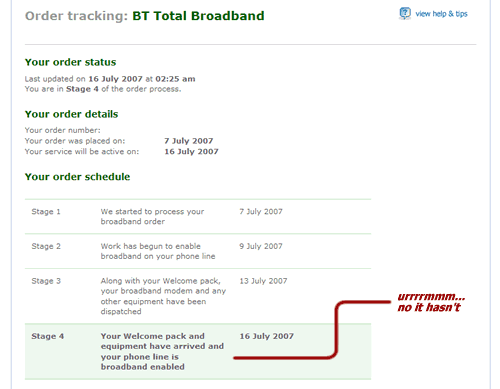
Now BT have a site for tracking customer orders. I went there yesterday to see that I’d reached step 4 in the process. My equipment had arrived and a faster broadband was connected.

BT order tracker claiming they've completed the order

Well not quite. No equipment arrived and the broadband connection was down.

If you are going to offer on-line order tracking, make sure it reflects fulfillment reality.

Tortoise Subversion is a simple and elegant tool for version controlling files. It is generally used on software development projects; it would be interesting to know how widespread it’s use is outside IT. For example, marketeers are enthusiastic PowerPoint users. When collaborating on documents they will generally share them via email, changing the file name with each revision, (e.g. salesdeck-0.1.ppt salesdeck-0.2.ppt until it is finished with salesdeck-1.0.ppt. But inevitably a 1.1 or 2.0 will rear it’s ugly head before it goes out).

Some organisations use rather heavyweight intranets / document management systems such as Sharepoint; could this be over-engineering when a lightweight tool such as Subversion could do the job almost just as well. This thought was recently confirmed when we were demonstrating how we would be sharing files using Subversion to our stakeholders. I demonstrated creating and checking in a document, and then showed someone else working on it, all from the familiar starting point of Windows Explorer. One of the guys from the business who’d never seen this before was incredulous. “And we’ve just spent $$$$$ on installing SharePoint. Why did no-one suggest this?!” Good question. As was “oh, by the way, Tortoise Subversion is free”, but it didn’t seem appropriate to say that at the time!

Brand has importance and value, but sometimes organisations can get too hung-up on the sanctity of their brand.  They don’t seem to like it if their brand brings on a smile…  Remember Coca-Colas attitude to the exploding mentos in a bottle of coke.  Rather than seeing it as free advertising (and associating their product with a positive emotion) they got hung up on the rational connotations and considered it didn’t “fit with the brand personality”.  This is certainly not the case with a kitchen appliance from Blendtec.  How is this for brand irreverence, blending the product of the moment, an iPhone on their viral marketing site willitblend.com.

Bubblegum generation presents a compelling model for Apple’s iPhone strategy:

1) Pick an industry which sucks (ie, imposes significant nuisance costs/menu costs/externalities on consumers)
2) Redress the imbalance by making something consumers love
3) …Which disrupts the long-standing industry equilibrium, and shifts market power
4) Use said market power to redesign (a hyperefficient) value chain

Don’t think that organisations in industries that suck don’t aspire to “do an iPod”. Go to any proposition development or product strategy workshop and it won’t be long before someone is mentioning Apple products. Yet all too often they fail to do anything truly revolutionary; they end up doing something different rather than “Redress(ing) the imbalance by making something consumers love”.

Do customers want something that is different or something that is just better?

Interestingly, little functionally in the iPhone is new. Like every other phone on the market it makes phone calls, sends messages, receives emails, takes photos and allows users to listen to music. Nothing different or new there… other than being better than every other phone on the market.

What Steve Jobs espouses is the experience of the phone. He says “So, we’re going to reinvent the phone. Now, we’re going to start with a revolutionary user interface… Now, what’s the killer app? The killer app is making calls! It’s amazing, it’s amazing how hard it is to make calls on most phones.”

He’s not looked to do anything radically different, rather do it radically better.

So how do you bring revolution to your product set? Rather than trying to be different, why not try to better. Make something that consumers love?

Take a leaf from the Apple book and focus upon the experience. Design and attention to detail are critical. Moving beyond purely functional and satisfying products to crafting experiences that engage the emotions. In agile product development it is often easy to focus upon delivering functionality that is perceived to deliver business benefit, yet end up with a mediocre product that has little resemblence to the original idea it was meant to become. Incremental delivery is a key feature of agile; it means you get stuff out there early and often. The challenge is to identify what that stuff is. To make something that consumers love using the agile approach, in addition to great developers and focussed project management, you need three people;

1. A passionate sponsor who has a dream and a vision and can articulate that to the team, banishing mediocrity from the outset
2. A business analyst who will help the team slice the functionality according to consumer needs and desires; that take the consumer of the journey they want to travel, not a predefined route that constrained to picking those features that eventually will deliver greatest value.
3. A customer experience architect, interaction designer or graphically minded usability dude who can champion the product aesthetic and usability.

Get them on your side and maybe you might be taking the first step on developing a better gizmo that your consumers will love, and sleep outside your retail outlet for hours to buy one.

Next Page »