August, 2008

Do you know what you are doing?

Recently I was told of a Blue Chip company whose IT organisation, in the guise of cost cutting, has recently disbanded its QA function. From now on, testing will be conducted by the developers themselves. Since when have developers relished the role of testing? It is inevitable that this cost cutting solution will end up costing the organisation more than it saves.

At the end of last summer I was working with a bank on their on-line retail banking strategy. During a workshop with representatives from their mortgage business they made it clear that they saw the biggest sector for growth in 2008 was the buy-to-let market. I left the workshop shaking my head, were they not reading the same newspapers I was? Even then I didn’t need a crystal ball to tell them that they were putting their eggs into the wrong basket.

Clearing out old paperwork, I came across a document describing the technology strategy for a blue chip organisation that I’d worked with in the past.

There is a guiding principle that is being applied to product technology selection that says we do not follow a ‘best-of-breed’ approach, but rather select a major technology leader (IBM) and ride their product development cycle. This means we explicitly seek and accept the “80% solution” rather than trying to optimise for each and every possible requirement. [We are] emphatic on this point. What this means in practice is that, following the selection of IBM WebSphere Application Server… add-on functionality should be sought from the IBM WebSphere family of products first. Shortcomings will be made explicit in order that we can escalate with IBM, and influence their product strategy.

No rationale was given for their preference for going with a single vendor rather than a best of breed solution, but talk to developers who have used best of breed products and the above mentioned vendor product and they will almost certainly come down on the side of the “best of breed” (that is why they are best).

During the dot-com boom I worked with bank who were developing a WAP mobile banking platform. Trouble was it could only be accessed via a Nokia 7110 (the first mobile phone with a WAP browser), the experience sucked – “Worthless Application Protocol” and the market penetration was never going to reach beyond the most hard-core (and GUI-patient) of early adopters.

At the time the same bank was intent on closing as many branches as possible – branch banking was considered unprofitable; on-line was the way forward… yet several years later I was back in the same bank helping them with their in-branch customer experience.

We all must have examples of times when we have shaken our heads and asked of others do they really know what do are doing? Whose interests are their decisions in aid of? You may not be able to do anything proactive about it at the time, but the question is, what can you learn from these encounters and how can you use them to teach others in the future.
Can you use the downturn to your advantage?

In the current market conditions the easy and obvious thing to do when turning to cost cutting is to wield the knife heavily on IT. New projects get culled, recruitment freezes and contractors get laid off as IT spend shrinks. This is a knee-jerk reaction and rarely in the long term interests of the oganisation. Surely the current market downturn should be seen as an opportunity to invest in IT, use the slack period to improve processes when they are not stressed, and get ready for the upswing when the economy turns.

What if an RFP was an Open Day?

We recently completed writing a response to an RFP. It weighed in at just under 100 pages with almost 34,000 words. OK, so there was a lot of copying and pasting going on, but that is not an insignificant amount of effort. Multiply that by the number of suppliers who were invited to respond; add the time taken for the client to produce the RFP itself, then review responses and answer questions and it is clear that RFPs consumes a lot of everybody’s time. With the winner taking all, that is a lot of wasted effort. But hold! That is only the first stage! The list of suppliers is whittled down and a beauty parade follows. Yet more effort is spent by two or three vendors turning their word document into a bunch of PowerPoint slides. A favoured supplier is identified and a process of negotiation follows, based upon estimates and what little information the supplier knows. Finally the supplier is selected, inevitably their are surprises on both sides when the engagement starts.

So the RFP process is a standard (but inefficient) way of doing business. What if it was done a different way?

One of the more significant decisions you make in your life (if you have children) is where you will send them to school. It is not a decision you make lightly as it will have a major influence on how your child grows up in the world. In the UK the government provides data (league tables) but this can only tell you so much; there is more to education that the statistics tell (which are historical and do not necessarily reflect the current reality your child is going to face). You will probably ask around – seek the wisdom of the crowd. Undoubtedly the community can identify good schools and bad schools. But the best judge of a school is to go there, to look around, to meet the teachers, to see the children. Do you trust the leadership of the head? Would you be happy for this person to teach your child, would you like your child to play in this playground, (and more importantly) grow up with these children?

So why not apply this thinking when looking for a supplier to build you an application? At the end of the day, projects succeed on personalities and relationships. Will the vendor get on with the buyer? The RFP tells you little about that. What if the RFP process was like seeking a school for your child? What if you had a project open day where you welcomed suppliers in, got to meet them, and maybe even got them to compete against each other.

What if you had three intense days when the business, IT and prospective invited suppliers come together to define the project and complete against each other in teams to come up with the “best” solution.

What if you provide the suppliers with details of what you are looking to achieve and request a basic qualifier – company details, profitability etc (the stuff that goes on every RFP) and a list of clients they have built similar products for (not exceeding one page of A4 per client). And for costings you ask them to provide you with their proposed rate card.

What if you then invite all suppliers to a large venue with a space for everyone to gather, and break out areas for the individual suppliers to work in. You start with background and presentations from the business and from IT. You tell the story of what you want, the vision, a description of the current technology, constraints, assumptions, known risks, integration points, etc. You provide some initial direction as a large group, but then breakout into supplier teams, interspersing each team with your people – from IT and the business. You provide technology (access to your systems, whatever is needed) and domain expertise. What happens next is up to the suppliers. They then have two days to impress.

What if at the end of each day each supplier presents their output to the whole group. The following morning you outline what you like of the outputs and ask the teams to take that as input to work on. Then at the end of the last day each vendor puts in an anonymous sealed envelope with their estimate (resources required to build the application). Can this triangulation technique be any less accurate than the estimate given on the back of several pages specification in an RPP?

If we accept that IT projects are about people, implemented by people, then the benefit of this approach is that you get to work with the supplier and experience the relationship first hand, rather than through documents and practiced PowerPoint presentations. And for the supplier it reduces the time taken to respond and will be more enjoyable for those involved. After all, don’t people prefer to do rather than write about what they do?

Cross cultural considerations at the Sandwich bar

In their paper Content preparation for cross-cultural e-commerce: a review and a model, Liao et al. conclude that (1) Westerners pay more attention to information about product components or contents than East Asians and (2) East Asians pay more attention to information about price… than westerners. This is in the context of eCommerce in “present[ing] appropriate information content to facilitate consumers’ decision making”.

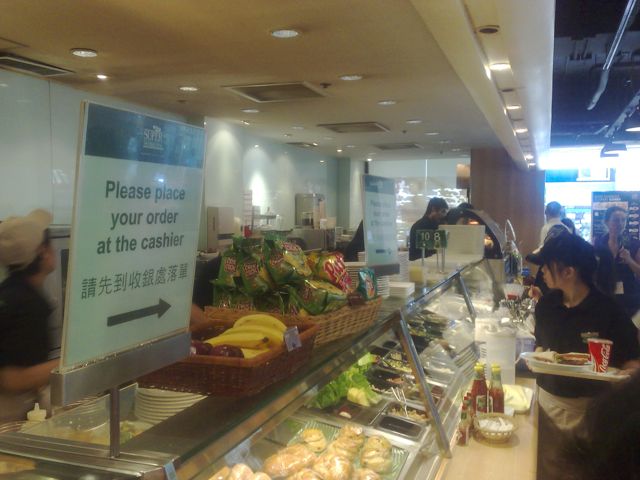
A practical example of this in the bricks and morter world can be seen at this Sandwich bar in Hong Kong.

Sandwich bar counter

Clearly modeled on the western way of buying sandwiches, the counter layout supports the customer selecting the product (sandwiches and fillings on display) moving on to the cashier at the end of the counter to pay.

This isn’t the way things are done in Hong Kong where money comes first before the product. “Please place your order at the cashier”… before dwelling in front of the display cabinet. This results is congestion around the cashier counter and poor workflow and a slow and tedious customer experience.

Sandwich bar or internet offering, consider cultural differences before transferring the concept and content.